- Home
- Business compliance
- CERPAC & Expatriate Quota Consultant in Nigeria
CERPAC & Expatriate Quota Consultant in Nigeria
Hiring foreign nationals in Nigeria requires two linked approvals, an Expatriate Quota for your company, and CERPAC for each expatriate's legal residence.

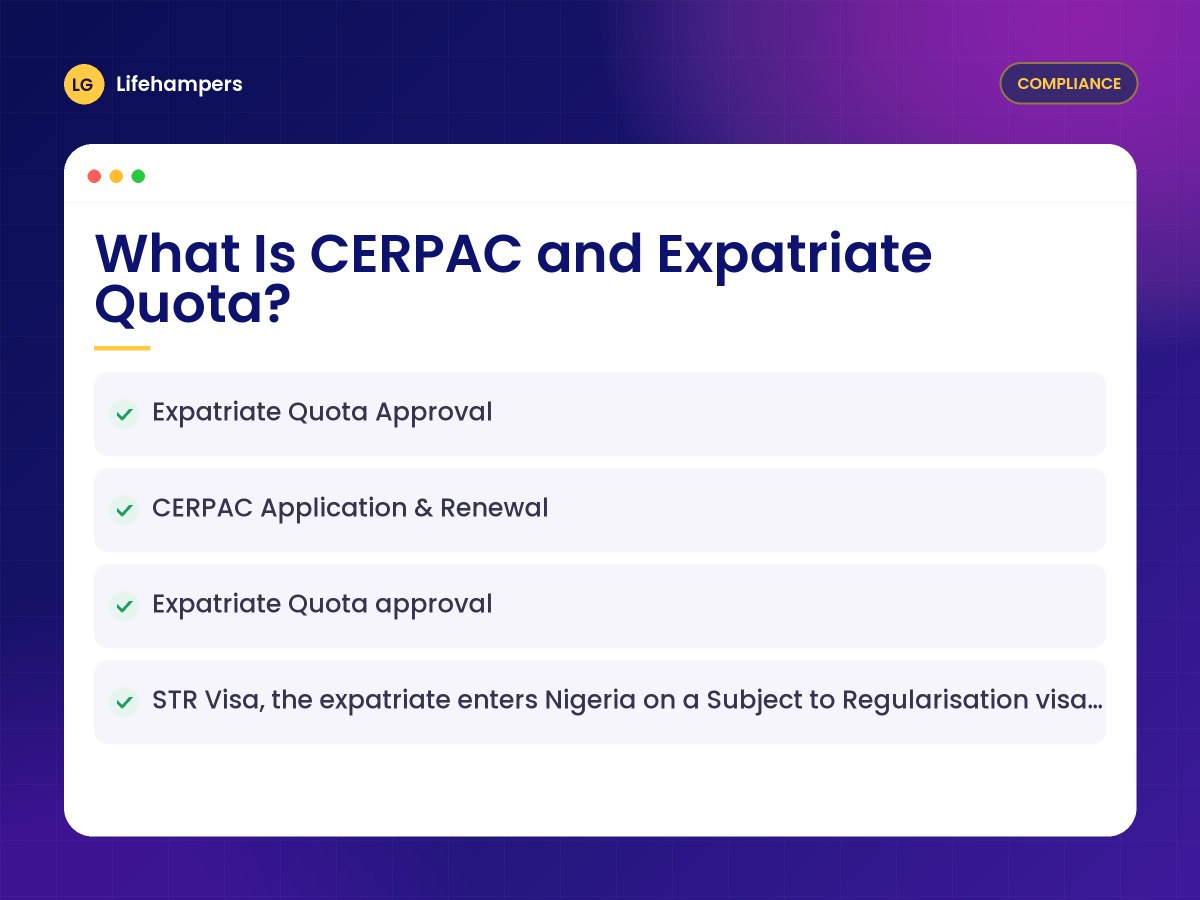
What Is CERPAC and Expatriate Quota?
Nigeria's system for employing foreign nationals is built around two linked approvals. The Expatriate Quota authorises a Nigerian company to employ a specific number of foreign nationals in approved roles. CERPAC (Combined Expatriate Residence Permit and Aliens Card) is the residence permit that lets each approved expatriate legally live and work in Nigeria.
The process is employer-led and regulated by the Ministry of Interior and the Nigeria Immigration Service (NIS). It's commonly used for senior management, technical specialists, and roles where local skills are limited, employers must justify the need and often support a localisation or understudy plan.
Detailed service pages:
The Expatriate Quota & CERPAC Process
- Expatriate Quota approval the company applies to the Federal Ministry of Interior through the Expatriate Administration System (EAS), with at least two Nigerian understudies per role
- STR Visa the expatriate enters Nigeria on a Subject to Regularisation visa tied to the approved quota
- CERPAC application submitted fully online through the NIS portal after arrival (paper forms ended in August 2025)
- Biometric data fingerprints and photograph captured at a designated NIS office
- Card issuance a temporary card is issued first while the permanent CERPAC is processed
Cost
CERPAC costs $2,000 per expatriate (a rate set by the Ministry of Interior), plus separate Expatriate Quota and business permit fees. Costs are entirely separate from CAC registration.
Validity
CERPAC is typically issued for up to two years and is renewable, subject to the continued validity of the underlying Expatriate Quota.
Questions people often ask
Straight answers to the questions we hear most often.
Can an individual apply for an Expatriate Quota?
No. Only a company can apply for an Expatriate Quota, individuals, whether Nigerian or foreign, are prohibited from applying directly.
Do I need to incorporate my company before applying?
Yes. Your business must first be incorporated with the CAC, the Certificate of Incorporation is required for both the Expatriate Quota and CERPAC applications.
How long does the process take?
Expatriate Quota approval and STR visa processing can take several weeks, and CERPAC itself is typically issued within 2–4 months of arrival, with a temporary card issued in the meantime.
Is CERPAC the same as a work permit?
CERPAC combines residence permit and identity card functions, it's the document that confirms an expatriate's legal right to live and work in Nigeria, tied to their employer's approved quota position.
What happens if the CERPAC expires?
The expatriate must renew before expiry to maintain legal residence status, operating on an expired CERPAC exposes both the employee and employer to compliance risk.
Hiring Foreign Talent for Your Nigerian Business?
Lifehampers Global Consults can guide your company through Expatriate Quota and CERPAC applications, alongside CAC registration and other compliance needs.